Matchup at a glance
PitcherStat calculationCategoryComparisonWhy
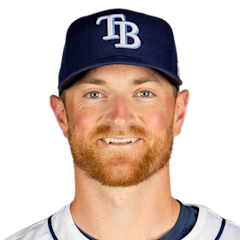
Starting pitcherRaysThe starters are close overall, but Rasmussen owns the better strikeout and control profile.
Offense vs handRaysTampa has produced the stronger offense against right-handed pitching.
Recent formRaysTampa has won 7 of its last 10 and owns the stronger recent run differential.
PowerYankeesNew has 132 home runs this season, 45 more than Tampa.
WeatherLow impactWeather conditions are expected to have little effect on the normal scoring environment.
Starting pitchers
2026 season (MLB rank among qualified starters)
2026 season (MLB rank among qualified starters)
How the starters differ
·Rasmussen allows fewer baserunners, with a 0.90 WHIP compared with 1.14.
·Rasmussen strikes out 2.2 more batters per nine innings.
·Rasmussen has produced a quality start in 80% of outings versus 0%.
·Blackburn allows the lower home-run rate: 0.77 vs 1.02 per nine.
How the lineups match the starters' pitch mix
Pitch data coverage: partial. Usage and velocity only.
Blackburn arsenal
| Pitch | Usage | Velo |
|---|
| Sinker | 34% | 94.3 |
| Changeup | 21% | 87.5 |
| Cutter | 20% | 91.8 |
| Curveball | 14% | 81.1 |
| Sweeper | 7% | 83.8 |
| Four-seam | 3% | 94.7 |
| Slider | 1% | 85.6 |
Rasmussen arsenal
| Pitch | Usage | Velo |
|---|
| Cutter | 29% | 90.0 |
| Four-seam | 28% | 95.8 |
| Sinker | 24% | 95.3 |
| Changeup | 13% | 89.6 |
| Curveball | 3% | 80.1 |
| Sweeper | 3% | 84.5 |
Team OPS vs opposing starter's hand
0.714OPS
.600.700.800.9001.000
0.752OPS
.600.700.800.9001.000
Lineups
Final lineupsOrder from the stored snapshot; treat as unofficial until the card is filed.Full lineup page Team comparison
Offense NYY·
NYY· TB
TBAVG.235 26th.258 1st
OPS.720 14th.728 8th
Home runs223 2nd169 22nd
Runs739 11th736 12th
OBP.311 24th.326 5th
SLG.409 7th.402 12th
PitchingNYY·TB1stMLB rank30th
ResultsNYY·TB+3634th
Run differential
+3615th
Frequently asked
Who is starting for the Yankees?+
Paul Blackburn (2.31 ERA, 2–1) is listed as the starter.
Who is starting for the Rays?+
Drew Rasmussen (2.78 ERA, 7–4) is listed as the starter.
What time does the game start?+
1:10 PM ET at Tropicana Field.
Where is the game being played?+
Tropicana Field, home of the Tampa Bay Rays.
Are the lineups confirmed?+
Not as official league cards. The orders shown are the current projected or last-posted lineups.
How have the Yankees and Rays performed head-to-head?+
Season series: Rays 4–9 this season.
How do the starters compare on P-Score?+
P-Score is available for one starter only.