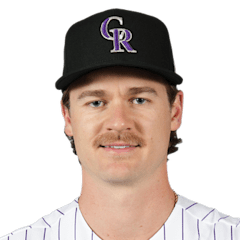


Colorado Rockies
Chicago Cubs at Colorado Rockies (2026-06-11). Edward Cabrera vs Ryan Feltner at Coors Field.
Edward Cabrera takes the mound for the Cubs with a season ERA of 4.99 and a WHIP of 1.42 across 57.2 innings pitched in 11 starts. His K/9 stands at 8.27, coupled with a BB/9 of 3.28, indicating a tendency for walks that can inflate his pitch count. While his trend ERA is currently noted as "down," suggesting recent improvement, his quality start percentage is 50 percent. Looking at his last five outings, Cabrera has allowed 0, 0, 3, 3, and 3 earned runs, demonstrating a degree of consistency in avoiding significant blow-ups, though he has not been entirely dominant. For the Rockies, Ryan Feltner enters with a more favorable season ERA of 4.22 and a WHIP of 1.16 over 32 innings in 7 starts. Feltner's K/9 is lower at 6.47, but his BB/9 is also more controlled at 2.81. Despite the better surface-level season ERA, Feltner's metrics reveal a 16.7 percent blow-up rate and a significantly lower quality start percentage of 16.7 percent, suggesting less reliability over deeper outings. His recent starts include allowing 0, 4, 6, 2, and 2 earned runs, which highlights a greater volatility compared to Cabrera, particularly the 6 earned runs in 4 innings against San Diego. Both pitchers are right-handers, which may influence platoon splits for opposing lineups.
Offensively, the Chicago Cubs present a slightly stronger unit, boasting a team OPS of 0.720 and having scored 308 runs this season. Their plate discipline is notable with 294 walks against 567 strikeouts, contributing to a 0.332 on-base percentage. Conversely, the Colorado Rockies hold a team OPS of 0.710 and have accumulated 294 runs. Their offensive approach features fewer walks at 212 and more strikeouts at 610, resulting in a lower 0.318 on-base percentage. Pitching-wise, the disparity is more pronounced. The Cubs' staff maintains a collective ERA of 4.33 and a WHIP of 1.25, demonstrating a more effective overall pitching performance. The Rockies' pitching staff, however, struggles significantly with a team ERA of 5.51 and a WHIP of 1.51, indicating a propensity to allow baserunners and runs at a higher rate. This considerable difference in pitching effectiveness, particularly at Coors Field, sets a challenging environment for the home team's pitchers.
Recent head-to-head matchups from 2025 saw the Cubs win five of six games against the Rockies. These contests included scores such as 11-7 and 5-6, indicating that offensive production has been a factor in past meetings between these clubs. The total line for this game is set at 11.0, a figure that aligns with expectations for a game played at Coors Field, known for its hitter-friendly conditions. The combination of the Rockies' struggling pitching staff, Feltner's potential for blow-up starts, and the inherent offensive environment of Coors Field supports the elevated total, suggesting potential for runs from both sides despite the Cubs' slightly superior pitching.
Away batters facing Ryan Feltner have limited prior experience. Alex Bregman is 0-for-3 with a .000 OPS in three plate appearances, and Ian Happ is also 0-for-3 with a .000 OPS in three plate appearances. Dansby Swanson has a .333 average and a 1.000 OPS, going 1-for-3 in six plate appearances, while Carson Kelly is 1-for-1 with a 2.000 OPS in his lone plate appearance. Pete Crow-Armstrong, Michael Busch, Seiya Suzuki, Nico Hoerner, and Moisés Ballesteros all have no MLB history against Feltner.
Home batters against Edward Cabrera also show a mix of limited history. Willi Castro has performed well, going 2-for-5 for a .400 average and a 1.000 OPS. Edouard Julien is 0-for-3 with a .000 OPS in three plate appearances, and Ezequiel Tovar is 0-for-4 with a .000 OPS in four plate appearances. Hunter Goodman is 0-for-1 with a .500 OPS in two plate appearances, while TJ Rumfield, Troy Johnston, Cole Carrigg, Sterlin Thompson, and Brett Sullivan have no MLB history against Cabrera.
Both lineups feature a similar number of batters with prior history against the opposing starter, indicating limited overall familiarity for either side.